
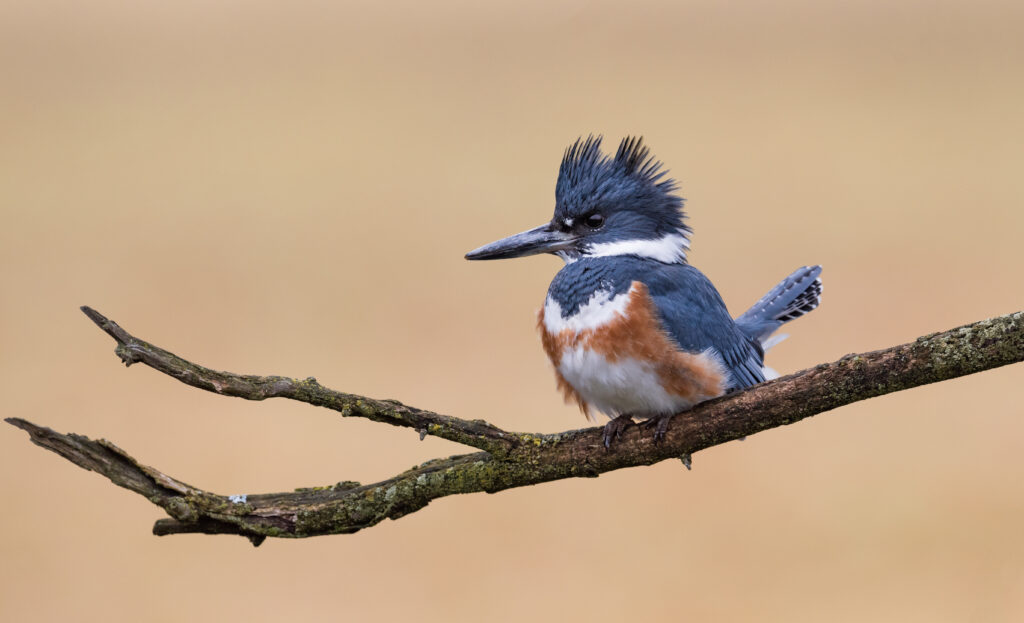
Megaceryle alcyon
Habitat, Diet & Status
- Habitat
- Streams, rivers, estuaries, coastal dunes with ponds, and lake shorelines where open water and earthen banks for nesting are both present. A common year-round resident along the Oregon Coast and throughout most of the state.
- ESA Status
- Not Listed
- Diet
- Primarily small fish; also crayfish, frogs, salamanders, mollusks, aquatic insects, and occasionally small mammals or berries. Hunts by plunging headfirst from a perch or hovering before diving.
The Belted Kingfisher is hard to miss and even harder to ignore. Its wild, rattling call announces its presence long before you spot it perched on a snag or wire above the water, crest raised, scanning the surface below. Stocky and top-heavy, with a slate-blue back, white collar, and a blue band across the chest, the kingfisher is one of the few bird species in which the female is more colorful than the male; she wears an additional rufous band across her belly. When prey is spotted, the bird plunges headfirst into the water with precision, snatches its meal, and returns to its perch to stun it against a branch before swallowing it whole.
The River's Lookout
The Belted Kingfisher's presence along a stretch of water is a reliable sign that the ecosystem beneath the surface is functioning. As a top predator in both freshwater and coastal food webs, it depends on clean, clear water with visible prey and stable earthen banks for nesting. Both parents excavate a burrow tunnel up to six feet deep, often directly over water, where they raise a clutch of six or seven eggs. Because kingfishers feed primarily on small fish, they are sensitive to water quality, sedimentation, and the kinds of habitat disruption that degrade Oregon's coastal streams and estuaries.
Populations remain stable for now, but the kingfisher's dependence on two specific conditions, clean water and exposed earthen banks, makes it vulnerable to the same forces threatening many of our coastal species: erosion from poorly managed land use, stream channelization, and the loss of riparian vegetation that holds banks in place and shades the water that fish and birds alike rely on.
What You Can Do
Support riparian restoration projects that stabilize stream banks and replant native vegetation along waterways. Advocate for land use practices that reduce erosion and runoff into coastal rivers and estuaries. If you see a kingfisher on your next walk near the water, take it as a good sign, and help keep those waterways worth returning to.
The kingfisher has inspired storytellers and naturalists for centuries, and it continues to do so today. ECC friend and award-winning Oregon nature writer Marina Richie devoted her first book for adults, Halcyon Journey, entirely to the Belted Kingfisher, tracing the bird's mythology, biology, and meaning across landscapes and cultures. It earned the 2024 John Burroughs Medal, one of the highest honors in nature writing. Her forthcoming book, Feathered Forest, follows birds through the ancient trees of Cascadia. Both are worth your time.